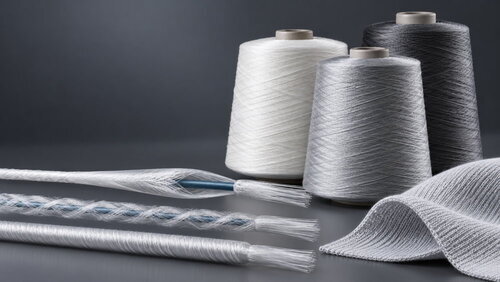
1. High-Stretch, High-Recovery Polyester-Based Elastic Solution Made with thermoplastic polyester elastomer (TPEE) filament, this solution combines elastomeric stretch and recovery with the processing advantages of thermoplastic materials. With appropriate yarn construction and fabric design, it can serve as a polyester-based alternative to conventional OP/spandex elastic yarns, providing stable fit, comfortable stretch, and durable recovery. 2. Customizable Composite Yarn Constructions TPEE can be combined with PET, rPET, micro-denier DTY, FDY, ATY, or other polyester-based filaments according to customer requirements for hand feel, coverage, stretch, support, and fabric appearance. Available constructions include air-covered yarn (ACY), single-covered yarn (SCY), and double-covered yarn (DCY), balancing elastic-core recovery with the surface texture of polyester filament. 3. 40D and 210D Options with Broader Development Potential TPEE is currently available in 40D and 210D specifications, covering lightweight and refined applications through to higher-support elastic applications. Other deniers and filament-count configurations can also be developed according to target stretch, covering construction, fabric structure, and dyeing and finishing conditions. 4. Polyester-Family Circular Design for a Clearer T2T Pathway Combining TPEE elastic yarn with polyester filament retains stretch functionality within a polyester-family material system, reducing the use of dissimilar materials such as PU, OP/spandex, and nylon. Compared with conventional stretch blended fabrics, this approach provides a clearer material-design foundation for recycling, regeneration, and textile-to-textile circularity. To achieve a fully circular garment, sewing threads, labels, prints, coatings, and other trims should also be considered during product development. 5. Process Control for Faster High-Quality Product Development As a thermoplastic elastomer, TPEE requires an appropriate process window for each specification, covering pre-drawing, covering tension, air-interlacing or covering conditions, heat setting, and the thermal history of dyeing and finishing. DEOTEX combines composite-yarn processing, fabric trial production, and dyeing and finishing validation experience to help customers shorten sampling and adjustment cycles, developing high-performance textiles with stable stretch, appearance, hand feel, and quality.