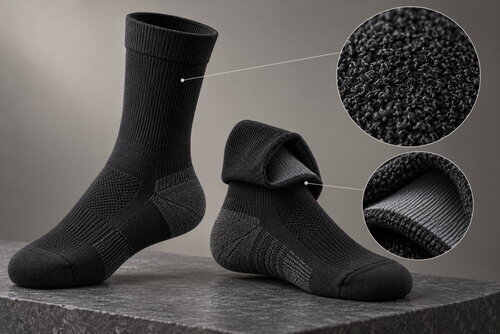
Qmaloft All-Polyester Smooth-Knit Socks
All-polyester smooth-knit socks protected by U.S. Patent No. US 12,584,251 B1 and Taiwan Invention Patent No. I923075
Code 132_001
| ## AFFT All-Polyester-Family 200-Needle Circular Socks AFFT develops 200-needle smooth-knit socks based on an all-polyester-family material design, combining functional polyester filaments such as PET, PTT, and TPEE. The result balances a refined appearance, comfortable stretch, and circular-design considerations. ## From Multi-Material Socks to a More Consistent Material Design Commercial socks often combine cotton, nylon, PU/OP elastic yarn, rubber yarn, and different sewing materials. While these materials can provide coverage, abrasion resistance, and elasticity, they also increase the difficulty of sorting and recycling after use. DEOTEX integrates face yarns, elastic structures, reinforced areas, and seam construction within a polyester-family material system to reduce the use of dissimilar materials and provide a more consistent basis for recycling, sorting, and remanufacturing. ## 200-Needle Fine-Gauge Smooth-Knit Design The socks use a 200-needle fine-gauge circular-knitting process with a smooth-knit construction, creating a refined, flat, thin, and close-fitting sock body. Compared with thick terry or bulky constructions, the 200-needle design delivers finer stitch definition and a lower-profile appearance, making it suitable for commuting, business wear, sports-casual use, and year-round wear. Functional zones can be configured according to product requirements: - The instep can use breathable stitch patterns or micro-mesh zones to improve airflow and comfort. - The heel, forefoot, and toe areas can use denser construction or reinforcement with polyester-family yarns for high-friction zones. - A wide, low-pressure elastic cuff provides stable coverage while reducing slippage and pressure marks. - The toe area uses automated flat toe-linking technology to improve long-wear comfort. ## Filament-Based Cotton-Like Hand and Comfortable Stretch The face yarn can use a PET/PTT composite ATY filament structure. Fine, short, non-directional micro-loops and irregular micro-texture form on the continuous-filament surface, creating a low-luster cotton-like hand and natural grip. This is not a conventional staple-fiber fuzz or brushed structure. The stretch system combines TPEE polyester elastic yarn with polyester filament, providing reliable stretch recovery and dimensional stability. It enables comfortable, soft, close-fitting all-polyester socks without relying on PU/OP elastic yarn. ##Product Positioning: Thin, Breathable, Abrasion-Resistant, and Pilling-Resistant AFFT All-Polyester-Family 200-Needle Smooth-Knit Socks are developed around fine-gauge thinness, zoned breathability, foot reinforcement, and filament durability: **Thin and smooth: The 200-needle construction creates a refined, low-profile sock surface without a bulky appearance. **Breathable comfort: Instep ventilation zones, loop density, and yarn selection balance airflow with quick-drying needs. **Abrasion resistance: High-friction areas at the heel, forefoot, and toe can use denser construction or reinforcement. **Pilling-resistant appearance: Filament construction, a smooth knitted surface, and appropriate finishing reduce visible fuzz and pilling risk. **Elastic fit: Coverage and recovery are balanced to reduce the sagging and deformation that may occur after repeated wear and laundering. ## Circular Design and Made-in-Taiwan Supply Chain AFFT extends all-polyester-family circular design to socks, underwear, T-shirts, POLO shirts, and other knitted products. Face yarns, ground yarns, seams, cuff structures, labels, and decorative materials are all included in consistent material management to reduce dissimilar-material interference and improve the feasibility of end-of-life recycling. From yarn production and sock knitting to product use, collection, and remanufacturing, the program can be developed through Taiwan’s local supply chain, creating a Made-in-Taiwan textile solution that combines product performance, durability, and resource circularity. ## Patents and Technical Foundation Qmaloft All-Polyester Smooth-Knit Socks are protected by U.S. Patent No. US 12,584,251 B1 and Taiwan Invention Patent No. I923075. |